
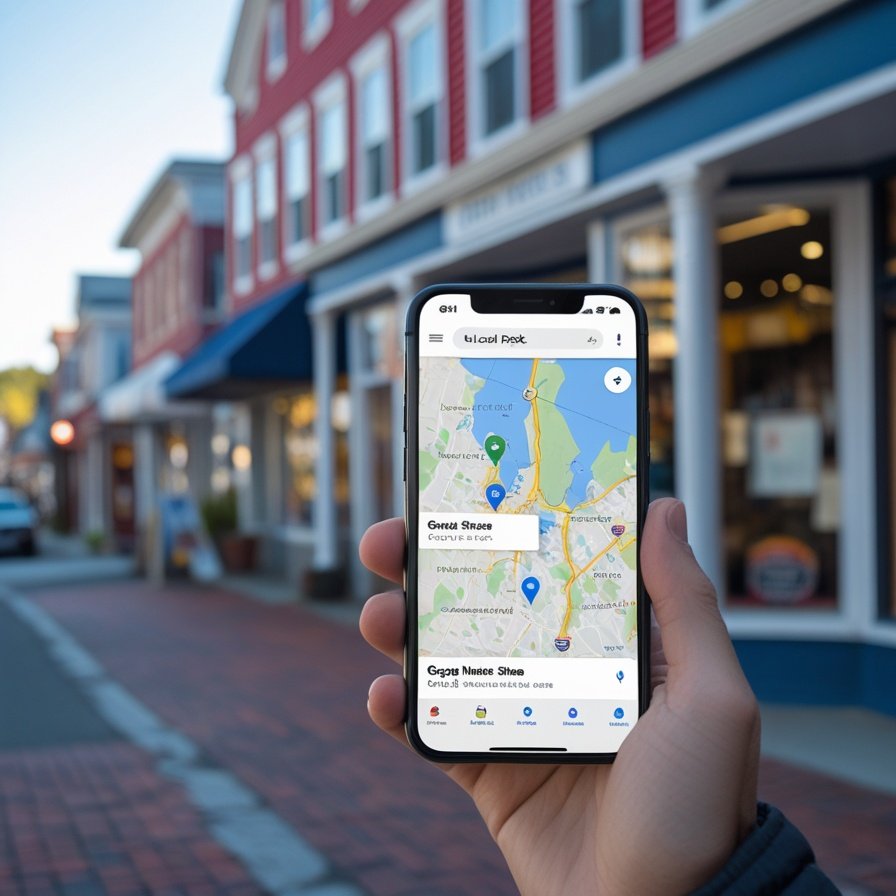
When someone in Portland pulls out their phone and types “breakfast near me,” or a homeowner in Bangor searches “plumber near me” at 9pm, one of two things happens: your business shows up — or your competitor’s does. There’s no third option, and on a phone screen, second place might as well be invisible.
It’s worth showing up for, too. Roughly three out of four people who run a local search on their phone visit a business that day, and about a quarter of those searches end in a purchase. That’s not idle browsing. That’s a customer with their wallet already out, deciding between you and the shop down the street.
Your Google Business Profile (GBP) is what decides who they find. It’s your storefront in Google Search, Maps, and voice results — and most Maine owners set it up once and never touch it again. That’s exactly the opportunity. A profile that’s genuinely optimized doesn’t just list your hours; it pulls in new customers around the clock. This guide walks you through it in plain English — no jargon, no engineer required.
The five-minute quick wins
- Make your name, address, and phone identical everywhere online.
- Choose the most specific category that fits — not just “Restaurant.”
- Open your description with what you do, where, and why you.
- Ask happy customers for reviews — and reply to every one.
- Post something fresh at least twice a month.
Why your profile is your hardest-working marketing tool
When someone searches for a business like yours, your profile can appear in the local pack (the top three businesses with map pins), the Maps results, and the knowledge panel — prime real estate, right where people make fast decisions. And unlike a new website that can take months to rank, a well-optimized profile can start pulling customers in within weeks, because Google deliberately favors local results when someone’s intent is “near me.”
Google’s local ranking comes down to three things:
- Relevance — how well you match what someone searched. Keywords drive this.
- Distance — how close you are to the searcher.
- Prominence — how known and trusted you are online. Reviews drive this.
Consistent business information affects all three. And since around 60% of local searches happen on a phone — often from someone on the move with immediate intent — every choice below should be made with that quick-scanning mobile customer in mind.
Step one: get your name, address & phone rock-solid
Before you touch a single keyword, nail your NAP — Name, Address, Phone. It has to match exactly across your profile, your website, your social pages, and directory listings like Yelp. Consistency tells Google you’re legitimate; even small mismatches confuse it.
“123 Main Street” on your profile and “123 Main St.” on your website can read as two different businesses. So pick your exact formatting once — Street or St., how you write the phone number, your real legal name — and use it everywhere. If you run more than one location, each needs its own unique address and phone number; shared numbers can get locations hidden from search.
One Maine-specific trap: if your hours shift with the season, keep them current. A “closed for the season” sign on the door doesn’t help if Google still says you’re open Sundays.
Learn how customers actually search
Here’s the gap that costs businesses customers: you describe yourself in industry terms, but your customers don’t search that way. You might call yourself an “automotive technician.” They type “car mechanic near me.” Match their words, not yours.
Urgency matters too. Someone with a dead furnace in February isn’t searching “HVAC system maintenance” — they’re typing “emergency heat repair near me.” Meet them at the exact moment they need you. Three free tools make this easy:
- Google autocomplete — start typing your service and note the suggestions. They’re real searches happening near you.
- “People also ask” — the questions Google lists are topics to address in your profile and posts.
- Your competitors — read the profiles and reviews of businesses ranking above you to spot the language that resonates.
And don’t skip seasonal and emergency terms — they’re gold in Maine. A landscaper should target “spring cleanup,” “snow removal,” and “storm debris removal.” A marina should think “winter boat storage,” “mooring service,” and “shrink wrapping.” A plumber wants “burst pipe repair” and “frozen pipe” front and center come January.
Pick precise categories — and leave your name alone
Your primary category heavily influences which searches surface your profile, so choose the most specific one that describes your main service. Don’t settle for “Restaurant” when “Italian Restaurant” or “Seafood Restaurant” will put you in front of more targeted searches with less competition.
Add secondary categories for your other services — a marketing agency might lead with “Marketing Agency,” then add “Web Designer,” “SEO Agency,” and “Social Media Marketing Agency.” Each one opens a new door into search.
What you should not do is stuff keywords into your business name. It violates Google’s guidelines and can get you suspended. If keywords are genuinely part of your registered name — “Casco Bay Auto Repair” — great. Otherwise, use your real name and let your categories and description do the work.
Write a description that sells on a phone screen
You get 750 characters, and most people read them on a phone, scanning fast. Lead with your primary keyword, your location, your value, and a promise — all in the first line.
Weak: “We’re a family-owned business proudly serving the community for 20 years.”
Strong: “Bangor’s trusted 24-hour plumbing contractor — emergency repairs, drain cleaning, and water-heater installation. Same-day service guaranteed.”
The second version tells a mobile user what you do, where, when, and why — with keywords that help you surface. From there, answer your customers’ real worries. A dental practice chasing nervous patients might write: “Gentle family dentistry with sedation options for anxious patients — painless cleanings, cosmetic work, and emergency care in downtown Portland. Free consultations and payment plans available.” That hits the fear, the services, the location, and removes the money barrier in one breath.
Mobile searchers don’t read — they scan. Tell them what you do, where you are, and why you in the first line, or you’ve already lost them.
Turn reviews into rankings
Reviews are one of the strongest levers you have — Google weighs how many you have, how good they are, how recent, and how you respond. Build them deliberately: hand out a direct link to your review page, send a follow-up email after the job, and train your team to ask during a happy moment. Just never pay or trade for reviews — that breaks Google’s rules.
Then reply to every review, working in natural keywords and your location. A response like “Thanks for trusting Casco Bay Auto with your brake repair — we’re proud to keep greater Portland’s drivers safe on the road” quietly reinforces what you do and where, for both Google and the next reader.
For negative reviews, respond fast and professionally, and focus on fixing it rather than winning the argument. Future customers aren’t judging whether you were right — they’re watching how you handle a problem. Replies are also a chance to surface services a reviewer didn’t mention: “Glad we could help with the oil change and tire rotation — we’re here for all your maintenance, too.”
Keep it fresh: posts, photos & reputation
Google Posts let you share offers, events, and updates right on your profile, and they lean into seasonal search. A landscaper posting “Spring cleanup now booking — we’ll clear the winter mess and prep your yard” in March catches exactly that wave of intent. Use posts to spotlight specific services people may not know you offer, and keep them coming — a profile with stale posts looks neglected and can rank worse for it.
Customer photos add authenticity that staged shots can’t. Invite them — a server can say “that lobster roll photographs beautifully, tag us!”; a contractor can ask for before-and-after shots of a finished job. Thank everyone who shares, and you’ll build a feedback loop that keeps the content coming.
Finally, watch your wider reputation. A free Google Alert for your business name flags mentions across the web so you can address a problem before it becomes a one-star review.
Optimize for the “near me,” voice-search customer
Mobile users have immediate intent and little patience, so your profile has to answer their questions instantly: what you offer, where you are, whether you’re open, and how to reach you. Keep your hours accurate (especially seasonal ones) and your phone number one tap away.
Plenty of those searches are spoken — “where’s the nearest coffee shop that’s open now?” — so write the way people talk and make sure your services and availability are spelled out completely. Then pull out your own phone and search for your business the way a customer would. If photos crawl or your description is buried behind “read more,” you’ve found your next fix.
Track what’s working
Your profile’s Insights show how people find and use it — search impressions, profile views, calls, website clicks, and direction requests. Watch the mix of discovery searches (someone found you by category or service) versus direct ones (they searched your name). A rise in discovery means your keyword work is landing.
Treat calls and direction requests as your high-intent signals. Lots of views but few calls usually means your description needs a clearer hook or call to action. Pair this with the free Google Search Console for even more keyword ideas, and put a recurring 30 minutes on the calendar each quarter to review and adjust — customer language and seasons both shift.
Quick starting lines, by business type
Steal these openers and make them yours:
- Restaurant: “Farm-to-table seafood on Portland’s working waterfront — handmade pasta, wood-fired pizza, and a deep Maine beer list. Vegan and gluten-free options.”
- Professional service: “Family law attorney specializing in divorce mediation and custody for families across Cumberland County. Free consultation, evening appointments.”
- Home service: “Licensed master plumber — emergency repair, water-heater installation, and drain cleaning across midcoast Maine. 24-hour service with upfront pricing.”
- Healthcare: “Board-certified pediatrician accepting new patients 0–18. Same-day sick visits and most insurance accepted, in Bangor.”
- Retail: “Independent bookstore with bestsellers, Maine authors, and rare finds. Special orders, monthly book clubs, and author nights in downtown Camden.”
The bottom line
Your Google Business Profile is one of the highest-return marketing tools a local business has. Unlike paid ads, an optimized profile keeps working around the clock without spending another dollar. Start today with the two that move the needle fastest — lock down your NAP consistency and rewrite your description — and you can see more views, more calls, and more customers within weeks. The businesses winning the map aren’t the biggest. They’re the ones who took the time to show up the way their customers actually search.
Rather climb the map without the DIY?
Epic Mobile Studios tunes Google Business Profiles for Maine businesses — the right categories, keyword-rich descriptions, a review engine, and monthly posts — so you rise in local search while you run your shop. Start with a free Local Search Audit and we’ll show you exactly where you’re losing customers, and how to fix it.
Hi, this is a comment.
To get started with moderating, editing, and deleting comments, please visit the Comments screen in the dashboard.
Commenter avatars come from Gravatar.